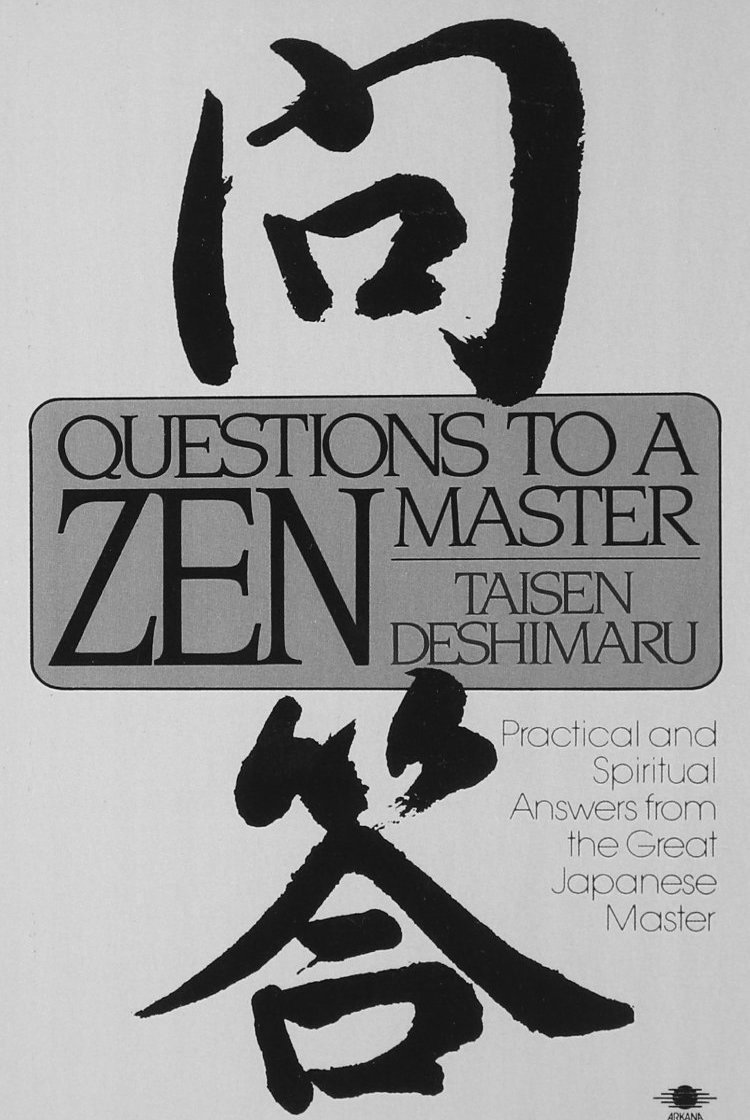
This is the book most people are handed first, and there is a reason for that. It has no argument to build and no system to set out. It is simply the questions Deshimaru's students put to him, and what he said back.
Published in French as Questions à un maître zen and brought into English by Nancy Amphoux, who practised under Deshimaru as Nan Shin, it appeared from Dutton in 1985 and has stayed in print through Penguin and Arkana editions since. At around 140 pages it is one of the shortest things in his bibliography, and one of the least decorated.
The questions come from ordinary French people in the 1970s, and they ask about ordinary things. How to sit. What to do with the pain in the knees. Whether thoughts can be stopped. How to breathe. But also: work, money, ambition, sex, marriage, raising children, illness, growing old, dying. Whether you have to become a monk to get anywhere. What to do when the practice stops feeling like anything. Deshimaru takes all of it at face value and answers in the same register, which is to say bluntly, often briefly, and without ever reaching for the vocabulary a reader might expect.
That refusal is the book's real content. By the time it reached English readers, Zen in the West had been shaped largely by scholarly and literary writing, by koan anthologies and by philosophical accounts of satori. Deshimaru worked in the opposite direction. He treated Zen as a physical practice belonging to eating and sleeping and going to work, and he was impatient with anyone who wanted to discuss it instead. Asked a metaphysical question, he tends to answer with a posture correction. It can read as evasion until you notice it is the same answer every time, which is the point.
The book also carries an exchange with Christian monks, a small section but a revealing one. Deshimaru spent time inside French abbeys, sitting with communities who shared his interest in silence, discipline and a life organised around a daily office. He is neither defensive nor accommodating with them, and the questions they ask are sharper than most.
Amphoux's translations are the cleanest doorway into Deshimaru's work. She knew the material from the inside and did not pad it. What survives is his voice in its awkward, forceful, funny compression, including the places where his French gave out and he said something stranger than he meant.
Practically, the format suits the way people actually read. You can open it anywhere, take one exchange, and close it again. Practitioners return to it for years for that reason, and it works just as well for someone who has never sat at all and wants to know what this is before committing an hour of a morning to it.